
This is an old revision of the document!
Table of Contents
it is ok for the moment. You can start — DokuWiki Administrator 2018/04/19 11:25
Where do the figures come from? Please cite the document as decribed in Welcome! — DokuWiki Administrator 2018/05/03 16:16
Radar Measurement
A radar system is able to measure with high accuracy the distance of an object. It uses electromagnetic pulses to detect the presence of a target in the following way: a transmitter emits a pulse of energy towards a given direction and if it bumps into an object part of the energy will be sent back. This “retransmitted energy” is called ECHO and according to its amplitude, the receiver will decide whether the target is present or not (by the comparison of the received signal with a given threshold), its distance and, if the target is moving, also its radial velocity. The measuring techniques regarding these aspects are all analyzed in this chapter.
Range
To begin our dissertation, let's assume that we have a radar system that is able to emit pulses of energy in any direction of the space in order to detect some desired objects. The shape of the transmitted pulse can be modelled as in fig.1. It has a rectangular envelope which duration is $\tau$ and its carrier is a sinusoidal waveform which has a wavelength equal to $\lambda$ and so frequency $f_0 = c/\lambda$.

Monostatic and bistatic Radar
The concept of monostatic and bistatic radar deals with whether the device used for transmitting and receiving is the same or not. Suppose to have a system like in fig.2, with a transmitter ($Tx$) emitting a pulse that hits the target which is $R_{T}$ far from it. If we can model the object like a single point (i.e. low dimensions with respect to the path covered by the e.m. wave), we are able to capture all the e.m. power that it will scatter back. In this particular case, the receiver is placed in a different position with respect to the transmitter, at a distance $R_{R}$ from the object and $L$ from the transmitter. This type of radar system is known as Bistatic Radar because we use two different antennas for transmitting and receiving, placed at two different distances from the target.

Suppose that the e.m. wave travels at the speed of light we can compute the time interval that separates the transmitted pulse with the received one:
\begin{equation} \Delta t = \frac{R_{T} + R_{R}}{c} \end{equation}
Once we know this value we can recover the value of $R_{T} + R_{R}$ that however does not give us the precise information about the distance of the target.
In practice, this kind of device is mainly used for weather radar. The bistatic radar technology has been in use for several years at the Institute of Atmospheric Physics at the German Aerospace Center. This system is also of some importance in military applications.
On the other hand, a lot of radar systems work with the same antenna on the $Tx$ and $Rx$ side. This is made possible to the presence of a special apparatus called Duplexer that disjoins the transmitting and receiving side. In this case, the distance that the e.m. wave has to cover in both paths is the same. We can then compute:
\begin{equation} \Delta t = \frac{2R}{c} \end{equation}
Calculating the time interval it is possible to recover $R$ that is the distance that separates the target from the radar. This kind of radar is called Monostatic Radar and it is shown in fig.3.

CW Radar systems
Until now it has been supposed that our radar system works with pulses of energy. Another typical waveform used by radar systems is the sinusoidal one. Radar using this approach are commonly known as Continous Wave radar (CW radar). It can be seen as a special type of bistatic radar because normally it uses two antennas for transmission. This radar schema was used in the first radar applications in history and nowadays it is almost deprecated because it doesn't allow to measure the distance of a target if the transmitted signal is not properly modulated. For this reason, FMCW radar (Frequency-Modulated Continuous Wave radar) is used.[3] It is a special type of radar sensor which radiates continuous transmission power like a simple continuous wave radar. In contrast to this CW radar, FMCW radar can change its operating frequency during the measurement: that is, the transmission signal is modulated in frequency (or in phase). In this method, the transmitted signal increases or decreases the frequency periodically. When an echo signal is received, that change of frequency gets a delay $\Delta t = 2R/c$ (by runtime shift) like the one obtained using pulse radar technique. In FMCW radar are measured the differences in phase or frequency (according to the modulation performed) between the transmitted and the received signal. This mechanism is shown in fig.4.

Range Resolution
Now we come back to consider monostatic radar that transmits pulses. Normally radar systems work in an environment in which more than one target is present. Consequently, when we want to measure the distance between the radar and the target we must be able to distinguish one object from one another. Weapons-control radar, which requires great precision, should be able to distinguish between targets that are only some meters apart. Search radar is usually less precise and only distinguishes between targets that are hundreds of meters or even miles apart. Resolution is usually divided into two categories: range resolution and bearing (angle) resolution.
Range resolution is the ability of a radar system to distinguish between two or more targets on the same bearing but at different ranges. This means that two (or more) targets must be detected by the radar as two (or more) different echoes. If $\tau$ is the duration of the emitted pulse we can derive that we are able to distinguish two different echoes on the receiving side if and only if:
\begin{equation} R_1 - R_2 > c\tau/2 = R_{min} \end{equation}
As we can see in fig.5, if the received echoes are overlapped the receiver sees just one waveform and it is not able to detect the presence of two different targets.

The first consequence is that pulse width is the primary factor in range resolution and we can define
\begin{equation} R_{min} = \frac{c\tau}{2} \end{equation}
as the amplitude in distance of the resolution cell.
Up to now, we have considered the transmission of just one pulse, but normally radar systems emit a new pulse after a certain period of time and repeat the revelation operation of all the received echoes.
Definition of PRT and duty cycle
The Pulse Repetition Frequency ($PRF$) of the radar system is the number of pulses that are transmitted per second. The time between the beginning of one pulse and the start of the next pulse is called pulse-repetition time ($PRT$) and is equal to the reciprocal of $PRF$ as follows:
\begin{equation} PRT = \frac{1}{PRF} \end{equation}
If $\tau$ is the pulse duration, we can define duty cycle the relationship $d = \tau/PRT$. Duty cycle is the fraction of time during which a system is in an “active” state. In particular, it is used in the following contexts: duty cycle is the proportion of time during which a component, device, or system is operative. Suppose a transmitter operates for 1 microsecond, and is shut off for 99 microseconds, then is run for 1 microsecond again, and so on. The transmitter runs for one out of 100 microseconds, and its duty cycle is therefore 1/100, or 1%. The duty cycle is used to calculate both the peak power and average power of a radar system. Pulsed radar transmitters are switched on and off to provide range timing information with each pulse. The amount of energy in this waveform is important because the maximum range is directly related to transmitter output power. The more energy the radar system transmits, the greater the target detection range will be. In general, we can define the average power radiated by the radar as follows:
\begin{equation} P_m = P\frac{\tau}{PRT} \end{equation}
where $P$ is the peak power. Fig.6 reports a sketch of this situation.

Resolution capacity can be improved making the pulse duration last less. On the other hand, if the transmitting power remains the same, this means to reduce the maximum distance at which the radar can look: high resolution and far distance are conflicting requirements that can be concealed with the pulse compression techniques, that are described later on.
Maximum unambiguous range
As we mentioned so far, radar systems periodically retransmit pulses and repeat the revelation procedure. For this reason, the problem of distance ambiguity arises. It becomes obvious that we cannot send out another pulse until a time window has passed, in which we expect to see a return echo. Consider the situation in fig.7

If the radar detects an echo in the position $A_2$, it cannot decide whether the object that generated the echo is due to the transmission of the first or second pulse because radar timing system reset to zero each time a pulse is radiated. In other words, we cannot decide whether the target is $ct_2/2$ or $(ct_2 + cT)/2$ far from the radar. The maximum range at which a target can be located so as to guarantee that it will be rightly detected is strictly related to the duration of the PRT. In other words, I want to receive the echo before I begin the transmission of the subsequent pulse. This range is called maximum unambiguous range or first range ambiguity. For this reason, pulse repetition time (PRT) of the radar is important when determining the maximum range because target return-times that exceed the PRT of the radar system appear at incorrect locations (ranges) on the radar screen. Returns that appear at these incorrect ranges are referred as ambiguous returns, second-sweep echoes or second time around echoes. Of course, if a target is placed exactly at a distance $R = cPRT/2$ or something multiple than this quantity, it won't be revealed because its echo will arrive in the period of time that radar uses to transmit and the receiver is closed: this phenomenon is known as “eclipsing loss”.
Range accuracy
Accuracy is the degree of conformance between the estimated or measured position at a given time and its true position.
Accuracy *should not be confused with resolution*, that otherwise, is the radar capacity to distinguish between echoes that belong to different targets. So we can try to define what are the waveform parameters that our radar should have to reach good performances in terms of accuracy.
Suppose to send a rectangular pulse whose width is $T$ at the instant $t = 0$ and that after a period $T_R$ we receive the echo associated to that pulse. Assuming that our receiving chain works with a matched filter approach (see next chapters) we can notice the situation described by the next figure.

Factors affecting measurement accuracy include not only noise and resolution but also signal and target characteristics and radar hardware considerations. [5]
For example, any uncertainty in the antenna boresight angle, due for example to mounting or pattern calibration errors or uncertainty, will affect the accuracy of a location measurement. Radiofrequency (RF) hardware or antenna gain calibration errors (gain uncertainty) will affect the accuracy of target signal power measurements.
Angle
To univocally identify the position of a target we must measure not only the distance but also the angle from which the scattered energy comes from. For this reason, very directive antennas are used, i.e. antennas that perform a radiation diagram with a maximum along a given direction.
Recall elements about antenna theory (Gain, Beamwidth, phased array)
As we mentioned so far, in this section we need to recall briefly what are the main features of an antenna that allow us to get a good performance in the field of radar measurements.
Let's give some definitions:[6]
- Radiated power
It is the integral of the Poynting vector over a closed surface around the antenna.
$P_r = \iint_A S(r,\theta,\phi)\hat{n}\,da\ \qquad$
where $\hat{n}$ is the versor orthogonal to the surface and $da$ is the infinitesimal element of the surface over which we compute our integral. - Radiation intensity
It is the radiated power normalized with respect to the solid angle unit along a given direction
$I(\theta,\phi) = \frac{dP_r}{d\Omega}$
This value is independent from the distance to the antenna. In case of Isotropic Source it is also independent of the direction and it is simply $I_0 = P_r/4\pi$, i.e. the total radiated power divided by the solid angle. It is important to notice that for any given antenna this quantity represent the average of the radiation intensity. - Directivity
It is the general radiation intensity normalized by the one of the isotropic radiator
$D(\theta,\phi) = \frac{I(\theta,\phi)}{P_r}4\pi$
It shows us how a given antenna is able to concentrate all the power towards a given angular position ($\theta,\phi$) with respect to the isotropic radiator assuming that the power radiated is the same. - Radiation diagram
It is the graphic representation of the radiated power at a given angle. In the following figure we can observe a section of the radiation diagram along the azimuth direction, $\theta$.
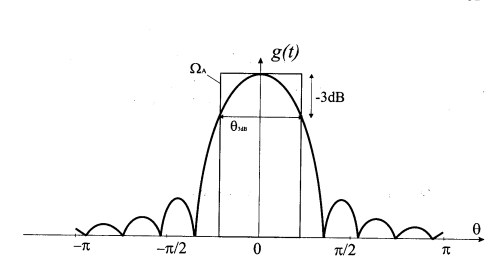
We are mainly interested in what happens when the gain is equal to $-3dB$ to univocally determine the characteristics of the antenna in terms of directivity. In fact, the lower the width of the main lobe the greater the value of the directivity.

We need to be very careful because in radar theory we use to flip the role of $\theta$ and $\phi$ angles. All the considerations about radar theory follow the scheme in fig.9 in which $\theta$ is the azimuth angle, while $\phi$ is the elevation angle.

To obtain a radar antenna we can use multiple solutions and each one has the aim to focus on the aperture an electric field with a certain amplitude and phase to reach a desired value for the far field. For example, in the microwaves field, we can realize two different systems as follows:
- Parabolic reflector
Considering geometrical optic's models, the following property stands: if we put a feeder in a given point called focus all the electromagnetic rays that bump into the reflector are parallel one to another, towards the same direction. This allows obtaining the desired field distribution.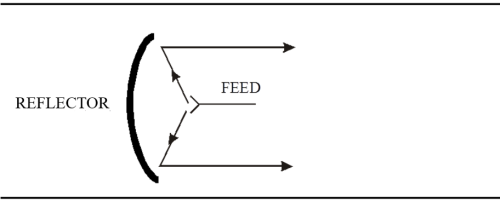
- Phased array
The same can be done using an array that contains more than one radiating element. All the elements are fed by a Beamforming Network and with respect to the phase shift between one element and the other we are able to switch the direction of the beam. For example to obtain the same performance of a parabolic reflector all the elements must be in phase (fig.10), but if we want to point the beam towards another direction, different from the straightforward one, we must introduce a phase shift $\Delta\phi$ between the elements (fig.11). If the array performs this type of beam shaping it is called Phased Array. In this way, we can avoid using mechanical features to move the antenna because the beam moves according to the phase shift.


Angle Resolution
After recalling all the concepts about antenna theory used by radar systems we can focus on how to catch a target also according to its angular position. First of all, we can define the position over which we get the maximum gain as Boresight. Usually, this direction has an elevation angle different from zero.

According to the requirements, we have to build in a proper way the antenna to get the right beamshaping for azimuth and elevation parameters. If we want a high angular resolution on both planes ($\theta$ and $\phi$) we need an antenna with a very narrow beam usually known as Pencil Beam. This kind of structure requires that $\theta = \phi$. Otherwise, if we don't need so much accuracy in measuring on the vertical plane we can realize an antenna with a narrow beam only on the horizontal plane. In this case we are dealing with the so-called Fan Beam antenna. If we use this last kind of beamshaping we are able to measure with a great precision only in distance and azimuth.
Such devices are used in the control of the air traffic, but only when the target can directly communicate its altitude.
It is quite easy to recognize which kind of beam an antenna is using just watching to its physical dimensions. For example, if an antenna is wider than longer its beam should be a Fan Beam. Otherwise is a squared antenna is used, it produces a Pencil Beam.
Using a Pencil Beam phased array it is possible to realize the so-called 3D Stacked Beams radar. The electronic scanning can be performed both on elevation and azimuth planes, but usually we prefer to perform a mechanical scanning on the azimuth plane and the electronic one on the elevation plane. In this way, we are able to measure also the altitude of the target. For this reason, this radar is called 3D, because it is able to locate the target in the 3-dimensional space giving the $R, \theta$ and $\phi$ coordinates at the same time.

Resolution cell
All the considerations made so far lead us to define the radar angular resolution as the interval of the solid angle delimited by $-3dB$ width of the main lobe, as shown in fig.14.

The surface $S_A$ is the portion of space in which if two objects stand at the same time they are not distinguishable from the radar on the angular point of view.
Remembering from the eq.(4) that $R_{min}$ is the distance resolution of the radar we can obtain the spatial resolution cell by intersecting it with the angular resolution one, obtaining a portion of space quite similar to a cylinder. (fig.14)

As we can see from the picture, the volume covered by the spatial resolution cell becomes bigger if we get far from the radar. Consequently, radar resolution power is bigger when two or more targets are as close as possible to the radar. To overcome this issue, nowadays we try to realize antennas with narrow beams to better detect the targets. This tendency is stressed out in meteorological radars where the antennas are very big (4-4.5m of radius) and main beams whose width is lower than one degree.
But what about the values of $\theta_B$ and $\phi_B$? In case the antenna is fed with a uniform distribution of the field over its surface a relation stands between the width of the main lobe and the diameter of the antenna: $\theta_B = 1.02 \lambda/D$.
But if we do not have any information about the field distribution we can use the following approximated relations:
\begin{equation} \theta_B = 65\frac{\lambda}{D_A} \qquad (degrees) \end{equation}
\begin{equation} \phi_B = 65\frac{\lambda}{D_E} \qquad (degrees) \end{equation}
where $\lambda$ is the wavelength and $D_A$, $D_E$ are the antenna's characteristic dimensions in azimuth and elevation, given with the same unit of measure of $\lambda$.
In the same condition, the gain $G_{max}$ is related to the dimensions of the main lobe through the following approximation:
\begin{equation} G_{max} = \frac{26.000}{\theta_B\phi_B} \end{equation}
Remembering that the effective area of the antenna is led to the gain by the relation
\begin{equation} G_{max} = 4\pi\frac{A_e}{\lambda^2} \end{equation}
For microwaves antennas without losses, the effective area $A_e$ is proportional to the real area $A$ of the apuerture:
\begin{equation} A_e = \rho_{A}A \cong \rho_{A}D_{A}D_{E} \end{equation}
If we take into account also antenna losses we must multiply the effective area for the loss factor $L_a$ that is less the 1. So we have:
\begin{equation} G_{max} = \frac{4\pi}{\lambda^2}\rho_{A}L_{A}D_{A}D_{E} \end{equation}
Velocity
Once we have defined the previous parameters that allow us to measure the distance from the radar, another information that can be derived from the echo signal is the radial velocity of the target. Of course, this quantity is revealed by the radar only if the target is moving.
Recall elements about Doppler frequency
When we deal with radar systems we face the following situation: there is a fixed object that radiates a pulse (the transmitting antenna); this pulse bumps into an object that most of the times is moving so when it scatters back the pulse towards the radar it implicitly becomes another source of sinusoidal waveforms but that this time is moving; finally this waveform is captured by the receiver that is already fixed.
It seems obvious that for the analysis of Doppler effects about radar systems two different situations must be combined:
- Fixed source with moving receiver;
- Moving source with fixed receiver.
First, assume that the sinusoidal waveform emitted by the radar has frequency $f_T$ and propagates at the speed of light $c$; its wavelength is $\lambda_0 = \frac{c}{f_T}$. If the receiver is approaching the source with a radial velocity $v_r$ (conventionally negative, when the receiver approaches) it detects waves with a different frequency $f_r$. This is due to its moving and, in the unit of time, it will receive a number of wavefronts $f_r > f_T$ if approaching, $f_r < f_T$ otherwise.
Suppose that $\lvert v_r\rvert << c$, the receiver that is approaching detects a receiving frequency equal to
\begin{equation} f_r = f_T - \frac{\lvert v_r\rvert}{\lambda_0} = f_T - \frac{\lvert v_r\rvert}{c}f_T = f_T\biggl(1 - \frac{\lvert v_r\rvert}{c}\biggr) \end{equation}
Being the source fixed the wavelength $\lambda$ remains equal to $\lambda_0$.
Now let's see what happens when the source is moving. If the source is approaching a fixed receiver, it will detect a wavelength that decreases according to the space swept by the source. So we have:
\begin{equation} \lambda_R = \lambda_0 + \frac{v_r}{f_T} = \frac{c + v_r}{f_T} \end{equation}
and the received frequency is:
\begin{equation} f_R = \frac{c}{\lambda_R} = \frac{c f_T}{c + v_r} = f_T \cdot \frac{1}{1 + (v_r/c)}. \end{equation}
As suggested at the beginning of this paragraph, to understand the behaviour of the radar in terms of Doppler effects we have to combine this two situations. If $f_{R1}$ is the frequency associated to the moving object, $f_{T1}$ the one referred to the re-irradiated wave and $f_{R2}$ the one finally received by the radar, for what we have just mentioned it is:
\begin{equation} f_{R1} = f_T\biggl(1 - \frac{v_r}{c}\biggr) \end{equation}
\begin{equation} f_{T1} = f_{R1} \end{equation}
\begin{equation} f_{R2} = f_{T1}\frac{1}{1 + (v_r/c)}. \end{equation}
Definitely, the radar receives a signal which frequency is:
\begin{equation} f_{R2} = f_T\frac{1 - \frac{v_r}{c}}{1 + \frac{v_r}{c}} = f_T\cdot\frac{\biggl(1 - \frac{v_r}{c}\biggr)^2}{1 - \biggl(\frac{v_r}{c}\biggr)^2} \end{equation}
In radar application it is:
\begin{equation} c \cong 3 \cdot 10^8\frac{m}{s}, \qquad v_r < 10^4\frac{m}{s} \end{equation}
$v_r$ is the upper bound of the velocity of low orbit satellites and ballistic missiles. So being $\frac{v_r}{c} < 10^{-4}$ we can neglect the term $\bigl(\frac{v_r}{c}\bigr)^2$ with respect to 1 and we can conclude that
\begin{equation} f_{R2} \cong f_T\biggl(1 - \frac{2v_r}{c}\biggr). \end{equation}
Doppler frequency
As we mentioned so far if we are dealing with targets that can be approximated by points, the received signal by the radar is a replica attenuated in amplitude and delayed in time and so in terms of sinusoidal waveform it can be seen as phase shifted with respect to the source.
The interesting case occurs when two or more consecutive echoes show a variation of this phase shift. This means that the target is moving and in the simpler case we can try to find the phase shift's frequency variation of the various echoes received. This frequency is known as Doppler frequency and we'll see that knowing this quantity we will be able to reconstruct the radial velocity of the examined target.
We begin to analyze the case of a radar that works with CW: in case of a pulse radar, we can consider the continuous wave (CW) as the carrier that modulates pulses. So the transmitted signal has the following structure:
\begin{equation} S_T(t) = \cos(2\pi f_0t + \alpha) \end{equation}
Assuming now that this signal bumps into a target, it will be scattered back and the receiver will see an attenuated replica of the same signal in a different instant of time:
\begin{equation} S_R(t) = kS_T(t - 2R(t)/c) \end{equation}
in which $R(t)$ is the distance of the target from the radar. As we mentioned before if the target is fixed $R(t)$ will remain constant and so the phase shift $\Delta\phi$ between $S_R(t)$ and $S_T(t)$.
But if R(t) changes in time:
\begin{equation} \phi(t) = -\frac{4\pi}{c}f_0R(t) \end{equation}
and so also $\phi(t)$ changes in time.
If we know the transmitted signal's phase, we can derive Doppler frequency through a relation that deals with the variation of this phase during different instants of receiving echoes:
\begin{equation} f_D = \frac{1}{2\pi}\frac{d}{dt}\phi(t) = -\frac{1}{2\pi}\frac{4\pi}{c}f_0\frac{dR(t)}{dt} = -\frac{2f_0}{c}\dot{R}(t). \end{equation}
The last step reveals that now we can have information about the radial velocity of the target, being $v_r$ the first derivative of the space with respect to the time ($\dot{R}(t)$). Knowing also the relationship between the frequency $f_0$ and the wavelength ($f_0 = c/\lambda$), we can derive the last equation that ties Doppler frequency and radial velocity:
\begin{equation} f_D = -\frac{2v_r}{\lambda} \end{equation}
The symbol - in the last equation means that if the target is moving towards the radar, and so the radial component of the velocity is negative, Doppler frequency is positive (approaching target).

Working with CW radar the presence of Doppler frequency shows up as an improvement or a reduction of the carrier frequency. So we can derive the value of Doppler frequency just as the difference between the frequency of the received signal and the frequency of the transmitted one. We have to remember that in case of a CW radar if the frequency of the transmission is $f_0$, on the receiving side a frequency equal to $f_0 + f_D$ is detected. A mixer is used to perform a beat with a signal of frequency $f_0$ (coherent detection) and so the output is a sinusoidal signal of frequency $f_D$.
All the speech made for treating CW radar can be extended to the case of pulse radar, making the right assumptions and modifications. In fact, in this latest case radar uses a sinusoidal wave modulated by a rectangular pulse. We will see in the next section that this phenomenon brings some difficulties in detecting the right radial velocity of the target.
Maximum unambiguous velocity
If a pulse radar sends a series of rectangular pulses with a period $PRT$, the output of the mixer is no more a sinusoidal signal of frequency $f_D$ as in the case of CW radar, but it is a sampling of this waveform at the instants $t_k = k \cdot PRT$. So, using a pulse radar is equivalent to introducing a sampling operation above the received signal with a period equal to $PRT$ equally spaced of multiples of $PRT$.
It is clear that if sampling is not performed in the right way we can incur the risk of “aliasing” over the value of $f_D$.
Let's suppose for example that the representative phasor of Doppler frequency has the following behaviour:
- $f_D = 3/4PRF$, so $2\pi f_D T = \frac{3}{2}\pi$.
In this case, the phasor that rotates counterclockwise with an angular speed of $\omega_D = 2\pi f_D$ is confused with another phasor that rotates with an angular speed $\frac{3\pi}{2T} - \frac{2\pi}{T} = -\frac{\pi}{2T}$ i.e, it seems to rotate clockwise and with a speed that is one-third of the real one. This is shown in fig.17.

In general, between the “folded” Doppler frequency $f^*$ comprised between $-\frac{1}{2T}$ and $\frac{1}{2T}$ and the real Doppler frequency $f_D = -\frac{2v_R}{\lambda}$ stands the Nyquist relation:
\begin{equation} f_D = f^* + kPRF = f^* + \frac{k}{T} \end{equation}
According to this law if the Doppler frequency of the received signal is less or equal to $PRF/2$ we do not have aliasing phenom. On the other hand, if $\lvert f_D\rvert > PRF/2$ we incur in undersampling that generates the aliasing phenom that shows up as a “folding” of the line at the frequency $f_D > PRF/2$ in the main interval that goes from $-PRF/2$ to $PRF/2$ (see fig.18).

Qualitatively we can explain the aliasing phenom taking into account the corresponding phasor to a sinusoidal signal that rotates in the complex plane: if this vector rotates with angular speed equal to $2\pi f_D$ and we catch it only in the time instants $t_k = k \cdot T$ we cannot distinguish it from another vector rotating with angular speed $2\pi(f_D \pm n/T)$, with $n$ integer.
So if we are working with a pulse radar to correctly extract the value of the Doppler frequency without ambiguity we have to respect the conditions imposed by the sampling theorem. This means that the $PRF$ must be such that
\begin{equation} PRF \ge 2\lvert f_{Dmax}\rvert = 4v_{max}/\lambda \end{equation}
where $v_{max}$ is the maximum value of the target's speed.
Coversely, once a certain value of a $PRF$ is assigned, the maximum value of the Doppler frequency that we are able to measure without ambiguity is:
\begin{equation} \lvert f_{Dmax}\rvert = \frac{PRF}{2} = \frac{1}{2PRT}. \end{equation}
Obviously, if we were using a CW radar we wouldn't have had the problem of Doppler ambiguity but on the other hand we would have problems with the range measurements.
Ambiguity cases
We can now understand that when we have to define the working characteristics of our radar system, we have to take into account the right choice of the $PRF$ value. According to its value, we have pointed out the following:
- Maximum unambiguous distance
\begin{equation} R_{max} = c\frac{PRT}{2} = c\frac{T}{2} \end{equation}
- Maximum unambiguous Doppler frequency to which is associated the maximum value of the radial velocity
\begin{equation} \lvert f_{Dmax}\rvert = \frac{PRF}{2} \rightarrow \lvert v_{rmax}\rvert = \frac{\lambda}{4PRT} = \frac{\lambda PRF}{4} \end{equation}
We can see that for a microwave radar it doesn't exist any $PRF$ value that can neglect at the same time velocity and distance ambiguity. For example, considering a wavelength of $\lambda = 10 cm$ (S band radar) if the target has a radial velocity equal to $v = 250 m/s$ the corresponding Doppler frequency is equal to $5 KHz$.
So if we want to avoid ambiguity in velocity, we should have $PRF > 10 KHz$. If we fix the value of $PRF = 10 KHz$ the maximum unambiguous distance reveals to be $15 Km$. This distance, of course, is not enough if compared with the maximum unambiguous distance required for the control of the air traffic.
We can now understand that we have to choose the value of the $PRF$ such that we can satisfy some of the specifications for which our radar is required to work. As always in engineering affairs, trade-off is the best way to act.
Distance unambiguous Radar
If we fix the maximum unambiguous distance that we want from our radar system $R_{max}$ we must have
\begin{equation} PRT \ge 2R_{max}/c \end{equation}
The maximum radial unambiguous velocity $v_{max}$ is equal to $c\lambda/8R_{max}$.
If we choose a value for the $PRT$ like in the last equation and the maximum radial velocity of the target $v_{rlim}$ is greater than the value $v_{max}$, we have realized a system that is unambiguous in distance but not in velocity.
So if we put on the plane in the next figure the distance and velocity values that identify the position of a given target in a given instant of time (points A, B, C), the radar will detect the situation showed in fig.b.

Fig.19b is obtained by “horizontally folding” upon the origin the rectangular portions on the $R-v$ plane that have a base equal to $\lambda PRF/2$ such to overlap them on the central portion, having $-\lambda PRF/4 < v < \lambda PRF/4$ in fig.a.
Fig.19c shows the distance-velocity plane with the velocity folded only on the positive plane.
Velocity unambiguous Radar
Suppose now that the parameter that you have fixed for your radar applications is $v_{rmax}$. In this case, the aim is to project a radar that is able to measure in an unambiguous way the radial velocity of at least a certain number of targets.
In this case, the minimum $PRF$ needed is equal to:
\begin{equation} PRF = \frac{4}{\lambda}\lvert v_{rmax}\rvert \end{equation}
If the maximum range of the radar $R_{lim} > \frac{c}{2PRF} = R_{max}$ we have to deal with a range ambiguous distance.
Like in the previous case we detect a significant difference (like shown in fig.20) between what really happens (case a) and what is detected by the radar (case b), analyzing the velocity-distance plane.

Fig.20b is obtained by a “vertical folding” over the rectangular portion centred on the origin and a length $R_{max} = c/(2PRF)$ of the other rectangular portion on the plane.
Distance and velocity ambiguous Radar
Now suppose to choose a PRF value such that called $R_{max} = c/(2PRF)$ and $v_{rmax} = \lambda PRF/4$ the maximum unambiguous distance and velocity rispectively, and $R_{lim}$ and $v_{lim}$ the maximum target distance and velocity. If it happens that $v_{rmax} < v_{rlim}$ and $R_{max} < R_{lim}$ we get a radar system that is both ambiguous in distance and velocity.
This situation does not fit very well with our purposes to use the radar, because it is clear that we can easily incur in some error during the measurements. Once again it is shown that the choice of a right value for the $PRF$ is a key aspect when a radar system is developed united with the right choice of the working band.
RVP
We can now define a value that can help us to rightly choose the value of the $PRF$ in order to better satisfy the user requirements. It is the product of the maximum unambiguous quantity, it is called Range Velocity Product (RVP) and it is equal to:
\begin{equation} RVP = v_{rmax}R_{max} = \frac{c\lambda}{8} \end{equation}
The first thing to notice is that this value only depends on the used frequency, and so it is strictly related to the choice of the frequency band in which our device should work.
We can, for example, use the $RVP$ to determine the range of frequencies that satisfy the imposed prerequisites in case of given $R_{lim}$ and/or $v_{rlim}$.
Suppose that we want to accept the detection of targets having $v_{rlim} = \pm 250 m/s = v_{rmax}$ located at a maximum distance of $R_{max} = 400 Km$. Making some calculation using the previous equation we can compute the $RVP$ and it results equal to $10^8$. Choosing a radar that works in L band we obtain $RVP = 8.62 \cdot 10^6$. So operating in L band (or any other superior bands), being $c\lambda/8 < v_{rmax}R_{max}$, whatever the choice of the $PRF$ we will always have ambiguity in distance, velocity or both.
According to what we have said until now, radar systems can be classified in the following way:
- High $PRF$ radar: it presents distance ambiguity, but not the Doppler one;
- Low $PRF$ radar: it presents Doppler ambiguity, but not the distance one;
- Medium $PRF$ radar: it presents both distance and Doppler ambiguity.
Usually, low $PRF$ radars are preferred for terrestrial surveillance and meteorological applications, while medium or high $PRF$ radars are used in avionic multifunctional applications.
Dwell Time
Assume to work with a pulse radar whose beam is able to move to scan all the space. If there is an object that can be approximated by a point at a certain distance it will be lighted up by the -3dB beamwidth of the antenna for a certain period of time. This target will be hit by a certain number $N$ of pulses transmitted by the radar. Consequently, on the receiving side, we will detect $N$ different echoes, attenuated and delayed, associated to the target. By definition, this number $N$ is equal to:
\begin{equation} N = PRF \cdot t_D \end{equation}
This new variable $t_D$ is defined as Dwell Time and is the timeframe during which the object is lighted up by the -3dB beamwidth.
If we perform an azimuthal scanning with a constant angular speed $\dot{\theta}$ and the width of the beam is equal to $\theta_B$, the definition of the dwell time is the sequent:
\begin{equation} t_D = \frac{\theta_B}{\dot{\theta}} \end{equation}
If the angular speed is given in rotation per minute (rpm) and the beamwidth in degrees, we have to use the following formula:
\begin{equation} t_D = \frac{\theta_B}{6\omega_{rpm}} \end{equation}
remembering that $1 rpm = \frac{2\pi}{60}[\frac{rad}{S}]$ and that $1^° = \frac{\pi}{180}$.
The physical meaning of dwell time is illustrated in fig.21.

All the pulses emitted during the dwell time are scattered back and received as echoes by the radar. The aim of the radar is the elaboration of these pulses so we have to identify a temporal window delimitating the sequence of pulses that bumps into the target. This window, of course, has a duration $t_D$.
If the azimuthal scanning is performed in a mechanical way the amplitude of the received pulses are weighted by a proper function (as shown in the previous figure) that takes into account the fact that during the rotation the gain of the beam that light up the target is changing (fig.22).

It is important to choose the weighting function in a proper way because it represents the envelope of the pulse sequence associated with a given target, $x(n)$. The envelope $r(n)$ of the sequence of the received echoes for a given target is equal to
\begin{equation} r(n) = x(n)w(n) \end{equation}
If the scanning is performed in a mechanical way the envelope shows a typically Gaussian shape. On the other hand, if Phased Array is used for scanning the shape of the weighting function is rectangular.
The Gaussian weighted function has the following expression:
\begin{equation} w(n) = exp\biggl(-2.7726\biggl(\frac{n - n_0}{N}\biggr)^2\biggr) \end{equation}
in which $n_0$ is the index of the central pulse and $N$ the number of pulses into the -3dB beam.
The observation that we can do is that the situation that occurs during a dwell time repeats after a period $T_{SCAN}$ that is the time that the antenna takes to perform a complete scanning on the azimuthal plane. This time can be constant or not, according to the application.
Making a brief summary, pulse radars work in a time window of duration $t_D$ (Dwell Time) and during this period we can collect $N$ echoes with respect to a given target. Due to the aliasing phenom associated with the sampling operation, the range of Doppler frequencies detectable without ambiguity is limited.
After this reasoning, we can understand that to determine the Doppler frequency we can count only on a limited number of echoes, the ones received during the dwell time. So it is not possible to distinguish two moving objects if their Doppler frequencies don't satisfy some conditions.
From the properties of the Fourier transform results that the ability to distinguish two targets according to the difference of their Doppler frequency $\Delta f$ is equal to:
\begin{equation} \Delta f = \frac{1}{t_D} \end{equation}
The measure of the Doppler frequency is mostly used to distinguish between echoes coming from fixed or moving targets; for this reason, sometimes it could be needed to use a value for the dwell time significantly high.
Temporal scales for radar signal
In this chapter all the measurements that a radar system is able to perform have been defined, taking into account the presence of a target approximable to a point, i.e. the object is very small with respect to the dimensions of the radar cell.
They are the sequent:
- Range;
- Elevation angle;
- Azimuth angle;
- Doppler frequency and radial velocity.
The results that we can obtain with respect to angular measurements depend substantially on the width of the antenna beam, so they can be optimized by a further improving the antenna requirements obtaining narrower lobes. On the other hand, when we talk about range and velocity we can incur in some ambiguity related to multiples of $v_{rmax}$ and $R_{max}$.
If we analyze the reception phenom about the pulses that were previously transmitted by the radar, we can divide the temporal axis into three different scales used to better understand the radar behaviour.
The first one is the one related to the pulse length, of the order of microseconds; then there is the one related to pulse repetition time larger than the previous, of the order of milliseconds; at last, there is the dwell time, of the order of milliseconds too. The sketch in the next figure reports the aforementioned situation.

These scales are characterized by the values $\tau$, $T$, and $t_D$: the performance obtainable, in terms of accuracy and discrimination about velocity and range, strictly depends on these three values. In particular, it must be noticed the importance of the dwell time and so the number of pulses that the receiver can process to discriminate the Doppler frequency between different targets.
The corresponding frequency representation of the situation described by the last figure is shown in fig.24, assuming that N goes to infinity, i.e. the received signal has a period equal to $PRT$. The distance between two lines is equal to $PRF = 1/PRT$.

If we use a pulse radar we can observe the received signal only in time instants associated to the pulse coming from a given echo. It is like to assume to cut the signal off with a temporal window equal to $t_D$ with $N$ pulses, and so the spectrum in fig.23 makes a convolution with the Fourier transform of the temporal window that we can suppose to have a gaussian shape (and so its Fourier transform has a gaussian shape that lasts for $1/t_D$): in the next and last figure it is shown the spectrum of $R(f)$ that is the transform of each $r(n)$ obtained from eq.29.

This is just to say that if we consider that the Dwell time is finite and so also the number of pulses bumping into the target is limited, we cannot consider at the receiving side the whole spectrum resulting by the Fourier transform of the transmitted pulse. The window used to cut the signal lasts for a time equal to the Dwell time $t_D.$ This is why the resulting received signal has a shape like the one in fig.24: the result of the convolution between the sampled signal and the window implies a widening of every line in the spectrum equal to $1/t_d$.
More info in lecture notes FDR1 in diddatticaweb